
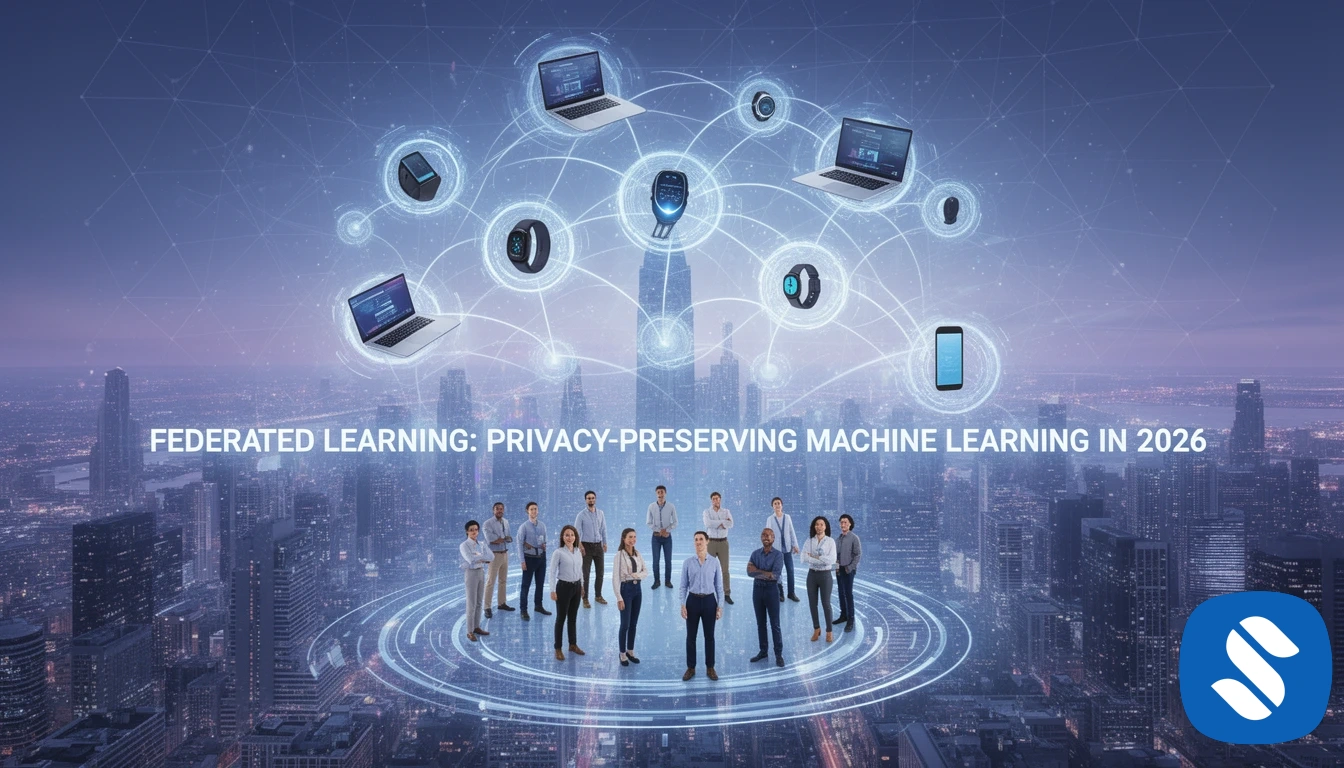
What Is Federated Learning and Why It Matters in 2026
Machine learning has always craved data. Centralized training on massive servers powered the AI boom we've lived through. But in 2026, with privacy regulations tightening and users more aware than ever of how their data gets used, a radically different approach is reshaping the field: federated learning. Instead of collecting raw data into a single place, federated learning brings the model to the data. Smartphones, wearables, hospital servers, and IoT devices train locally on private information, and only model updates never the raw data are shared. This shift turns data privacy from an afterthought into a foundational design principle.
The timing couldn't be better. Laws like GDPR, the California Consumer Privacy Act, and similar frameworks around the world demand stricter control over personal data. Traditional centralized training often violates the spirit and sometimes the letter of these regulations. Federated learning offers a technical solution that aligns with both ethical AI practices and legal compliance. It’s not just a niche research topic anymore; it’s running in production across billions of devices, from Google’s Gboard keyboard to Apple’s Siri suggestions. As we move deeper into 2026, understanding federated learning is essential for data scientists, ML engineers, and anyone building intelligent, privacy-first applications.
How Federated Learning Actually Works
The core idea is simple, but the engineering underneath is sophisticated. A central server initializes a model and sends it to a large number of participating clients think mobile phones or edge nodes. Each client trains the model on its own local dataset, which might be your typing patterns, medical images, or sensor readings. After local training, only the model updates (gradients or weight deltas) are encrypted and sent back to the server. The server aggregates these updates typically using an algorithm like Federated Averaging (FedAvg) to produce an improved global model. This cycle repeats over many rounds, gradually building a powerful shared model without ever seeing anyone’s raw data.
A key point is that the data stays on the device. The model learns from patterns across thousands or millions of users without moving sensitive information. To protect against potential attacks that could reverse-engineer updates, modern federated systems often add differential privacy injecting carefully calibrated noise so that individual contributions are obscured, but the overall learning signal remains strong. Secure aggregation protocols, where the server can only see the combined update and not individual updates, add another layer of protection. These techniques are becoming standard in 2026 as the push toward truly private AI accelerates.
Real Benefits Beyond Just Privacy
Privacy is the headline benefit, but federated learning delivers several other practical advantages that make it indispensable for modern AI. First, it enables learning from decentralized data that would otherwise be siloed. Hospitals can collaboratively train a tumor detection model without ever sharing patient scans. Banks can build fraud detection systems across institutions without exposing transaction histories. This kind of cross-organization learning was nearly impossible before.
Second, because computation happens at the edge, federated learning drastically reduces data transfer costs and latency. Training on-device means the model can adapt in real time to a user’s behavior without round-trips to a cloud server. That’s why keyboard predictions feel so responsive the model is constantly learning your lingo right on your phone. In 2026, with the explosion of edge AI hardware, this kind of personalization has become seamless.
Third, federated learning is inherently robust to certain forms of data bias. Central datasets often over-represent a handful of demographics. By learning from a diverse, genuinely global set of devices, the aggregated model can reflect a broader population. This doesn’t automatically solve all fairness issues, but it’s a step away from the narrow viewpoint of a single curated dataset. Companies deploying federated systems must still audit for bias, but the decentralized nature gives them a head start.
The Biggest Challenges in Federated Learning Today
None of this is magic. Federated learning introduces tough challenges that researchers and engineers are still solving in 2026. Communication efficiency is a constant battle. Sending model updates over mobile networks is slow and expensive, especially for large models like vision transformers or large language models. Compression techniques, gradient sparsification, and adaptive aggregation schedules are active areas of innovation.
Non-IID (non-independently and identically distributed) data is another headache. Your phone’s usage patterns are nothing like your neighbor’s. This extreme statistical heterogeneity can destabilize training, causing the global model to converge slowly or even diverge. Algorithms like FedProx and SCAFFOLD were designed to handle such heterogeneity, and in 2026 they are widely used alongside personalization layers that allow a global model to be fine-tuned per user.
System heterogeneity adds more complexity. Devices vary wildly in compute power, battery life, and network availability. A federated round can’t wait forever for a low-end phone stuck on 2G. Straggler mitigation, client selection strategies, and asynchronous aggregation help keep the system moving without leaving too many participants behind. On top of all that, security threats like model poisoning where a malicious client sends corrupted updates require robust defenses. Techniques like Byzantine-resilient aggregation and anomaly detection are now integrated into production federated frameworks.
Federated Learning Frameworks and Tools in 2026
The ecosystem has matured dramatically. The open-source library TensorFlow Federated (TFF) remains a go-to tool for research and development. It provides a flexible platform for simulating federated algorithms and includes ready-to-use implementations of FedAvg, differential privacy, and secure aggregation. In 2026, TFF has native support for heterogeneous client orchestration and tight integration with TensorFlow Lite for on-device execution.
Beyond TFF, PySyft by OpenMined provides a privacy-first framework that combines federated learning with secure multi-party computation. Flower (FL) is another popular framework that emphasizes ease of use and scales from simulation to production with thousands of clients. Major cloud providers now offer managed federated learning services. Google Cloud’s Vertex AI includes federated training pipelines, and similar services exist on AWS and Azure, making it easier than ever for enterprises to deploy privacy-preserving ML without building the entire infrastructure from scratch.
Real-World Applications That Are Changing Industries
Federated learning isn't just theoretical. In healthcare, the NVIDIA Clara Federated Learning platform enables hospitals worldwide to collaborate on medical imaging AI models without sharing patient records. In finance, federated models detect fraud by learning patterns across multiple banks, each keeping their transaction data strictly on-premises. Smart assistant improvements like better voice recognition or next-word prediction now happen entirely on-device for hundreds of millions of users, thanks to federated learning.
Autonomous driving is another frontier. Fleets of vehicles can collectively improve perception models by training on real-world sensor data while never uploading video clips or LiDAR scans to a central server. Each car contributes learnings from its unique driving environment, making the overall system more robust to edge cases. In 2026, even industrial IoT deployments use federated learning to optimize predictive maintenance across factory floors without centralizing proprietary operational data.
How to Get Started with Federated Learning Today
Diving into federated learning requires a shift in mindset but is highly accessible. Start by setting up a simulation environment with TensorFlow Federated or Flower. Define a simple model a logistic regression or a small CNN and experiment with the Federated Averaging algorithm on an IID dataset to understand the basic mechanics. Gradually introduce non-IID partitions and measure how convergence changes.
Then incorporate privacy guarantees. Add differential privacy using TFF’s built-in aggregators, which inject controlled noise. Explore secure aggregation methods to hide individual updates from the server. Once comfortable in simulation, test on real devices using TensorFlow Lite and a federated runtime like the one built into Android’s Private Compute Core. The path from a toy example to a production system is shorter than you think, especially with the mature tools available in 2026.
Remember, federated learning is as much a system design problem as a machine learning problem. Monitoring model quality, handling stragglers, and managing communication costs all require careful engineering. But the payoff models that respect user privacy, operate at the edge, and unlock previously inaccessible data silos is transforming how we think about AI.
The Future of Privacy-Preserving Machine Learning
Federated learning is just one piece of a larger privacy-preserving ML puzzle. In the coming years, expect tighter integration with fully homomorphic encryption, allowing computation on encrypted data without ever decrypting it. Combined with federated approaches, this could enable model training on completely inaccessible datasets. Split learning and vertical federated learning, where features are distributed across organizations rather than samples, will also gain traction.
Regulation will continue to shape the landscape. In 2026, compliance isn't optional. Federated learning gives organizations a concrete technical foundation to build ethical AI systems that users can trust. As users demand more control over their digital footprint, the ability to offer smart, personalized experiences without hoarding data will become a competitive advantage. The era of centralized, extractive data practices is fading. Federated learning is lighting the path forward.