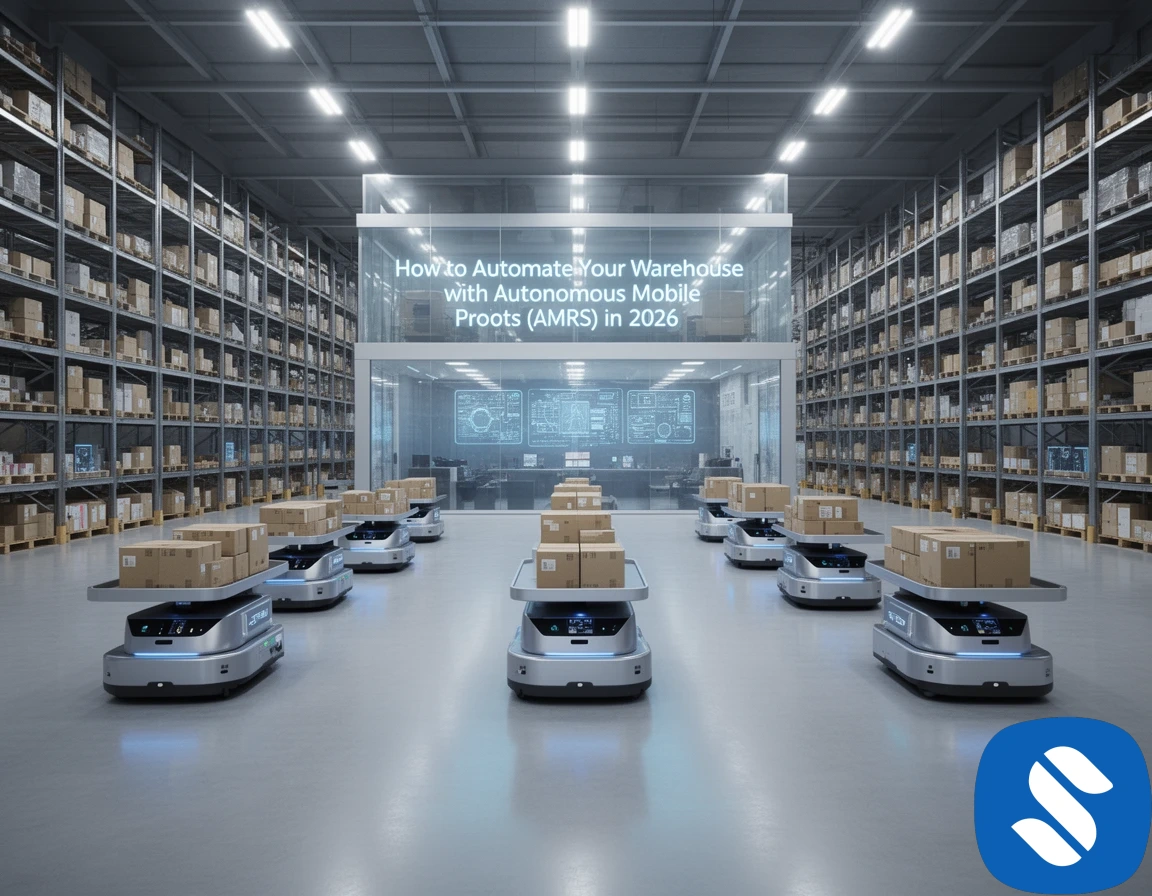
AMR Warehouse Automation Guide 2026: Real Steps, Real Results
If you run a warehouse, distribution centre, or fulfilment operation in 2026, you have probably already heard about Autonomous Mobile Robots. But you may still be wondering: are they just an expensive toy, or can they genuinely change how my business runs? The truth sits somewhere practical. AMRs are now mature enough to drop into brownfield sites without major infrastructure changes, and they pay back faster than most people realise. This article is not a glossy brochure. It is a field-level guide to bringing AMRs into your warehouse, written from the perspective of someone who has seen both the messy reality and the impressive outcomes.
What Exactly Are AMRs – and How Are They Different from AGVs?
Before diving in, let’s clear up the terminology. An Autonomous Mobile Robot (AMR) navigates using onboard sensors, cameras, and SLAM algorithms. It does not need magnetic tape, wires, or fixed routes. An Automated Guided Vehicle (AGV), in contrast, follows a predetermined path, usually with magnets or lines on the floor. That difference is huge: AMRs can dynamically replan around obstacles, operate safely alongside people, and adapt when your layout changes. In 2026, most new deployments are AMRs, but plenty of warehouses still use AGVs for simple point‑to‑point moves. Knowing which one fits your operation matters.
One of the leaders in this space, Mobile Industrial Robots (MiR), has hundreds of AMRs running in factories and warehouses globally. Their robots can tow carts, lift pallets, and integrate directly with conveyors. The open architecture also allows third‑party modules for custom jobs – a key point if your workflows are unique.
Step 1: Assess Your Warehouse Needs – Not Just the Robot’s Spec Sheet
The biggest mistake in AMR projects is buying a robot first and figuring out the problem later. Instead, start with a brutally honest assessment of your material flow. Map every movement of goods over a typical week. Where do people walk the most? Which transfer points cause delays? Do you have peak‑hour surges that break your current process?
From this analysis, define concrete missions for the AMRs. For example: “move finished goods from packing station 3 to dock door 7 every 12 minutes.” Or “replenish picking faces in zone B once inventory drops below 20 units.” Vague goals lead to under‑utilised robots. Specific missions let you calculate the number of robots needed, the battery capacity, and the required docking stations.
Step 2: Choose the Right AMR Platform and Payload Configuration
Not all AMRs are equal. You need to match the robot’s form factor to your loads. If you move mostly totes, a small shelf‑lifting robot like those from many vendors might work. For pallet‑sized loads, a heavier AMR with a lifting module or a tow hook is essential. Think about floor conditions too. A shiny epoxy floor versus a cracked concrete surface will affect traction and navigation accuracy.
In 2026, many AMRs support VDA 5050, a standard communication protocol for fleet interoperability. If you think you might mix brands later, choose a robot that speaks VDA 5050 and can connect to a central fleet manager. Locking yourself into a proprietary system can hurt scalability.
Step 3: Map Your Facility and Set Up Reliable Navigation
Modern AMRs use 2D lidar, 3D depth cameras, and sometimes ultrasonic sensors. Before deployment, you need a high‑quality map. The robot’s operator will drive it through all accessible areas while the SLAM algorithm builds a reference map. This is not a one‑click job; it requires patience. Pay extra attention to repetitive structures like long, straight aisles that can confuse lidar‑based systems. Adding visual landmarks or reflective markers can improve repeatability.
Make sure dynamic obstacles (like forklifts, pedestrians, and even pallet wrappers) are present during mapping so the robot learns the real environment. A map built in an empty warehouse over a weekend will fail on Monday morning when activity spikes.
Step 4: Integrate the AMR Fleet with Your WMS and ERP Systems
This is where the rubber meets the road. A robot that cannot talk to your warehouse management system is just an expensive floor sweeper. Most AMR platforms offer a REST API or a message broker interface (MQTT, AMQP). You will need to send mission commands, receive status updates, and trigger actions based on inventory events.
Here is a practical example. Suppose your WMS sends a move order. You could trigger an AMR mission with a simple HTTP call:
You must also handle errors gracefully – what happens if the robot gets stuck or the destination is blocked? Build a retry logic and an alerting mechanism into your middleware. Open‑source stacks like ROS 2 can help, but most production fleets use the manufacturer’s own fleet management software combined with a light integration layer.
Step 5: Train Your Team and Start with a Pilot Zone
AMRs are safe, but safety is a culture, not just a sensor suite. Train all floor staff on how to behave around robots. Teach them not to jump in front of a moving AMR “just to test it”. Set clear rules: stop and let the robot pass, keep aisles clear, and never remove safety stickers or covers. The first two weeks should run in a cordoned‑off pilot area with limited human traffic. Measure metrics: mission completion rate, battery change frequency, and any near‑miss events.
During this pilot, you will uncover hidden surprises – maybe the robot struggles with a particular ramp, or the Wi‑Fi coverage drops at the far end of the warehouse. Fix those before scaling.
Step 6: Scale, Monitor, and Continuously Optimise the Fleet
Once the pilot proves out, you can add more robots and expand to larger zones. At this stage, data becomes your best friend. Modern fleet managers provide dashboards with utilisation rates, battery health, and heat maps of robot traffic. Look for patterns. If one robot consistently waits at a bottleneck, maybe you need to add a charging station nearby or adjust the shift schedule.
Use the API to pull metrics into your own analytics tool:
In 2026, some platforms are even adding AI‑driven predictive maintenance that warns you when a motor’s current draw starts trending up – well before it fails. Use those features; they prevent costly downtime.
Real‑World ROI: Why It’s About More Than Labour Savings
You will often hear that one AMR can replace two or three full‑time employees. That is directionally true but misses the bigger picture. AMRs also reduce product damage (no more dropped pallets from tired workers), improve accuracy (missions are tracked digitally), and enable a 24/7 operation without overtime pay. They also make your operation more resilient. When labour is tight – a chronic problem in logistics in 2026 – a fleet of robots means you do not have to turn down orders.
A typical mid‑sized warehouse deploying four to six AMRs for pallet transport sees a payback in 12–18 months, often less if the robots run across three shifts. That is based on current vendor data and user stories shared at events like Automate 2025.
Common Pitfalls – and How to Avoid Them
- Skipping the network assessment: AMRs need solid Wi‑Fi or private 5G coverage. Do a site survey before deployment.
- Ignoring floor inclination: A robot rated for a 5% grade will struggle on a 7% ramp, causing drive faults.
- Under‑investing in change management: Staff fear robots taking their jobs. Involve them early, show how their roles evolve into robot supervisors, and address concerns honestly.
- Neglecting cybersecurity: Fleet managers exposed to the internet without proper authentication can be hijacked. Always use HTTPS, VPNs, and rotate API keys.
The Road Ahead: AMRs in 2026 and Beyond
We are past the “wow” phase. AMRs are becoming a utility, much like conveyor belts. The trend now is towards multi‑brand fleets managed by a single orchestration layer, with AI optimising the entire warehouse in real time. Standards like VDA 5050 and open APIs will accelerate this. If you start today with a solid, standards‑based foundation, you will be in a strong position to plug in whatever new technology arrives – whether it is a drone for inventory counting or a collaborative robot arm on an AMR chassis.
Automation is not about removing people; it is about removing the walking, the waiting, and the waste – so your people can focus on the high‑value tasks only humans can do.
Deploying AMRs in 2026 is no longer a leap of faith. It is an engineering project with a clear return. Follow the steps above, stay close to your operators, and let the data guide your decisions. Your warehouse will be quieter, faster, and far more adaptable.